
LFP vs Lead-Acid: Which Battery Is Better for Off-Grid Storage?
For most new off-grid systems, lithium iron phosphate (LFP) batteries deliver more usable energy, faster charging, lower maintenance, longer cycle life, and lower total cost of ownership than lead-acid batteries.
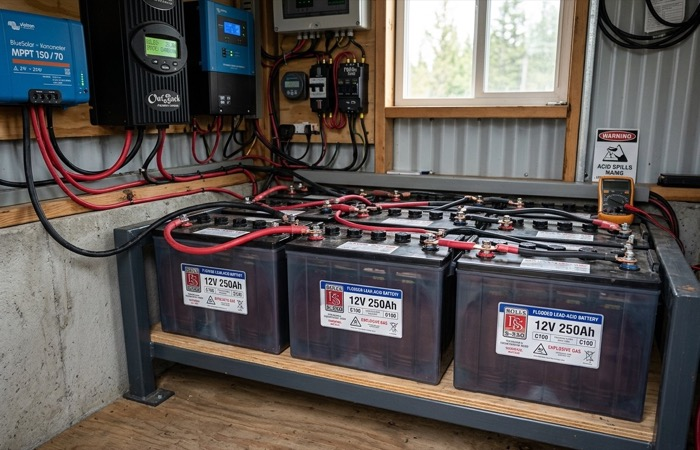
Do you still have a legacy Lead Acid Battery System?
There is no need to upgrade if your current battery system is working properly. If your pack is aging, you need more usable capacity, or you want to reduce maintenance, GridZero can compare a lithium iron phosphate replacement against keeping your current lead-acid bank.
Quick Comparison
The wrong comparison is purchase price only. The right comparison is usable energy, cycle life, maintenance, replacement cost, and how much work the system creates over time.
| Factor | LFP Lithium | Lead-Acid |
|---|---|---|
| Upfront cost | Higher day-one price, usually lower lifetime cost | Lower day-one price, often higher lifetime cost |
| Usable capacity | Higher usable share of nameplate kWh | Lower usable share for long life |
| Cycle life | Built for repeated daily cycling | Shorter under deep daily cycling |
| Charge efficiency | Higher, faster recharge | Lower, longer absorb stage |
| Maintenance | Low routine maintenance | More maintenance, especially flooded batteries |
| Total cost of ownership | Usually lower across the system life | Usually higher after replacement and upkeep |
| Footprint and weight | Smaller and lighter | Larger and heavier for same usable energy |
Most off-grid installs: LFP is our recommendation for just about every new off-grid energy storage system. Lead-acid is older technology that rarely competes once usable capacity, maintenance, replacement cycles, and total cost of ownership are counted.
LFP Lithium for Off-Grid Storage
LFP, also called LiFePO4 or Lithium Iron Phosphate, is a robust, stable, safe, efficient, high performance battery chemistry with excellent lifespan and longevity. It is generally our default recommendation for new off-grid battery systems, whether the bank cycles daily or only supports a seasonal property. The chemistry is stable, efficient, safe, and cost effective.
Chemistry snapshot
Lithium iron phosphate is the modern off-grid baseline.
LFP avoids nickel and cobalt which are expensive minerals, and tolerates deeper cycling, and keeps charge behavior simple for homes and cabins that need dependable stored energy without a maintenance routine.
- Better fit for daily deep cycling and repeated overnight discharge.
- Faster recharge from solar and generator charging windows.
- No routine maintenance and cleaner monitoring workflows.
- Smaller footprint for the same usable stored energy.
- No off-gassing or ventilation required.
LFP Longevity
A lithium iron phosphate battery rated at 6,000 cycles and used at 50% depth of discharge per day can provide functional maintenance free energy storage for 12,000 days, or about 32 & 1/2 years.
Quick calculator
Assumes one discharge and recharge per day at the selected depth of discharge. A 100% depth of discharge equals one full cycle; 10% depth of discharge equals 0.1 cycle. Actual service life also depends on temperature, charge rate, battery management, and manufacturer end-of-life limits.
Lead-Acid for Off-Grid Storage
Lead-acid is the legacy option. It can keep an existing system running, but for new off-grid storage it rarely makes sense: even budget-conscious and lightly cycled systems usually get more usable energy, less maintenance, and a lower lifetime cost from LFP.
Chemistry snapshot
Lead-acid is familiar, but it is no longer competitive.
Lead plates and sulfuric acid are proven and recyclable, but off-grid service usually means a larger bank, slower charging, more maintenance, and earlier replacement.
- Sometimes lower day-one battery purchase cost, but not usually lower lifetime cost.
- Mature U.S. recycling ecosystem and familiar service model.
- More sensitive to deep discharge in daily off-grid operation.
- Flooded variants require ventilation and regular maintenance.
Which One Should You Choose?
Choose LFP if…
- You are building almost any new off-grid energy system.
- You want lower total cost of ownership, not just the lowest invoice today.
- You want less maintenance and fewer replacements.
- You want more usable energy in less space.
Only Consider Lead-Acid if…
- You are keeping a working legacy bank in service for now.
- The project is a short bridge before a planned LFP upgrade.
- You require low temperature (below freezing) operation.
- You accept more maintenance, more space, and earlier replacement.
Practical recommendation: We recommend LFP for just about every off-grid energy storage project. Lead-acid is legacy technology; it rarely has a strong place in a new system once lifecycle cost, usable capacity, maintenance, and generator run time are considered.